Benchtop Jointer vs Floor Jointer: Which Suits Your Shop?
Choose a benchtop jointer if you work in a small or shared space, build smaller projects, or need to move the machine around. Choose a floor jointer if you regularly flatten long or wide boards, mill a lot of rough lumber, or want a machine you can keep for years. Floor models generally offer longer beds, more cutting width and more power, while benchtop models win on size and portability.
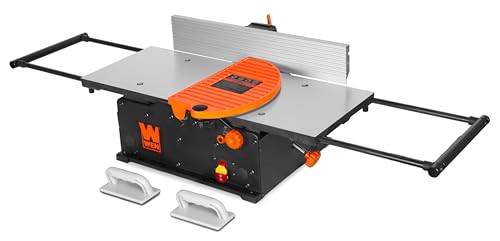 WEN JT1224HBest overall
 CUTECH 401120HI-IF#1 on our Best Score
 CUTECH 40180HBMid-size 8 in spiral
The short version: what really separates them
A jointer does one job. It flattens one face of a board and then squares an edge to that face. Benchtop and floor jointers do the same job, so the differences come down to scale: how long the beds are, how wide the cutterhead is, how much motor is behind it, and how much room the machine takes up.
Floor-standing jointers are the traditional shop machine. They sit on a heavy stand or cabinet, have long infeed and outfeed tables, and handle bigger stock with less fuss. Benchtop jointers shrink everything to fit on a workbench or a small stand. That makes them a real option for hobbyists, but it also sets limits on what they can do comfortably.
If you want to see how specific models stack up, our best jointer page covers both categories side by side.
Bed length and why it matters
The most important difference is table length. A longer bed supports a board along more of its length, which helps you take a long board down to a flat face instead of copying its bow or twist. Floor jointers typically have longer beds than benchtop models, and that gap shows up most when you work with boards of 5 or 6 feet and longer.
Short beds are not useless. Shorter stock, such as pieces for small boxes, cutting boards, drawer parts and frames, joints well on a benchtop machine. For longer boards, you can still get good results with a short bed, but it takes more care: light passes, steady pressure over the outfeed table, and sometimes extra support stands.
Capacity, power and the kind of work you do
Cutting width is the next big factor. Floor jointers are commonly sold in 6-inch and 8-inch classes, and many woodworkers see 8 inches as the better long-term pick if the space and budget allow. Benchtop jointers usually sit at or below the 6-inch class. A wider cutterhead lets you flatten wider boards in one pass, rather than ripping them narrower first or gluing up and planing afterward.
Power matters too. Floor machines generally pair bigger motors with heavier castings. That means they take deeper cuts in hard species with less bogging down, and the mass helps reduce vibration, which gives a smoother surface. A benchtop machine can handle hardwoods, but you will want shallower passes and sharp knives.
Think about what your projects actually look like:
- Small boxes, toys, cutting boards and shop jigs: a benchtop jointer is usually enough.
- Furniture with long legs, rails and tabletops: a floor jointer makes the work easier.
- Buying rough lumber and milling it yourself: a floor jointer saves time and effort.
- Mostly buying pre-surfaced boards and touching up edges: a benchtop jointer often does the job.
Side-by-side comparison
This table shows how the two types compare in general. For exact specifications on any one model, check its published data on our comparison pages.
| Factor | Benchtop jointer | Floor jointer |
|---|---|---|
| Bed length | Shorter | Longer |
| Cutting width | Narrower | Wider, often up to the 8-inch class |
| Motor power | Lower | Higher |
| Weight and stability | Lighter, more vibration | Heavier, steadier |
| Footprint | Fits on a bench or small stand | Needs dedicated floor space |
| Portability | Easy to move and store | Hard to move once placed |
| Best for | Small projects, small shops | Long boards, rough lumber, heavy use |
Space, dust and power supply
A floor jointer needs more than floor space. You also need room at both ends for long boards to travel through, and a way to collect chips. Jointers throw a lot of shavings, and a dust collector or a good shop vacuum with the right hose makes a big difference. Check the dust port size on any model you consider and match it to your collection setup.
Power supply is worth a look as well. Larger floor machines may call for a dedicated circuit or a different voltage than a typical household outlet provides, depending on the model. Check the electrical requirements in the published specifications before you buy, and have an electrician help if you need new wiring.
Benchtop machines are easier here. Most run on standard household power and can be stored away between jobs, which suits a garage shared with a car. If your shop doubles as something else, our best benchtop jointer page is a good place to start.
Safety basics for either type
A jointer has an exposed rotating cutterhead, so it deserves respect no matter the size. Follow these habits every time:
- Wear eye protection and hearing protection. Jointers are loud, and chips fly.
- Use push blocks or push pads when the board is thin or short, and never pass your hands over the cutterhead.
- Unplug the machine before changing knives or making adjustments.
- Keep the guard working and in place.
- Do not joint very short or very thin stock, and check boards for nails or screws first.
- Feed against the cutterhead rotation, with the grain direction in mind, to reduce tear-out and kickback risk.
- Tie back loose hair and clothing, and skip gloves near the cutterhead.
So which should you buy?
Start with the longest board you plan to work on and the space you actually have. If most of your stock is short and your shop is tight, a benchtop jointer is a sensible fit and will do honest work. If you mill long rough boards or build larger furniture, a floor jointer will save you effort and give you better results over time.
If you are unsure, think about the next few years. A machine that is slightly more than you need today is often easier to live with than one you outgrow, as long as you have the room and electrical supply for it. Compare the options on our best jointer page, then narrow down by bed length, cutting width and motor details.
Frequently asked questions
Can a benchtop jointer flatten a wide board?
Only up to its cutting width. If a board is wider than the cutterhead, rip it narrower first, or flatten it another way, such as with a planer sled or hand plane.
Do I need a planer as well as a jointer?
Usually yes, if you want boards with two flat, parallel faces. The jointer flattens one face and one edge, and a planer then makes the opposite face parallel to the first.
Is a used floor jointer a good idea?
It can be, since the heavy castings last a long time. Check that the tables are flat, the fence is square, and the bearings turn smoothly, and confirm the motor's electrical needs match your shop.
How often should I change or sharpen the knives?
Whenever the cut gets rough, tears out more, or leaves lines along the board. Dull knives are also a safety concern because they make you push harder.