Battery Charger and Air Compressor Combo vs Separate Units
A combo is the better fit if you want one compact emergency kit for a car or small SUV and only inflate tires occasionally. Separate units make more sense if you have a large diesel engine, need to fill many tires or inflate bigger items often, or want to replace one tool without the other. In both cases, check the pump's max PSI and the starter's peak current against your own vehicle first.
 birvsw DM1264Strongest truck jump power
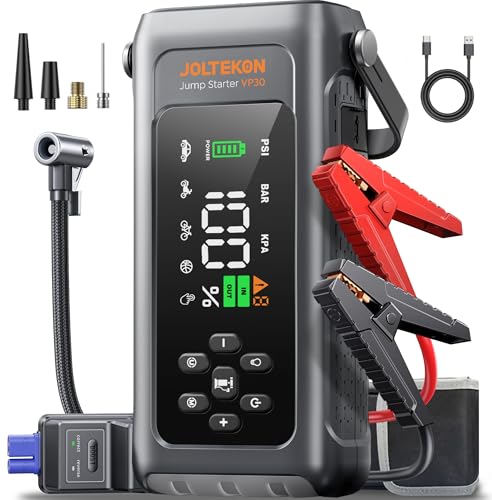 Joltekon VP30Balanced combo for cars
 NACKEO N30High pressure, light body
What a combo actually is
When shoppers search for a battery charger and air compressor combo, they usually mean a portable jump starter with a built-in tire pump. It has its own internal battery. It can start a dead car battery, inflate a tire, and often charge a phone. It is not the same as a wall charger that tops up a battery over several hours.
That difference matters for the comparisons people ask about. A combo versus a plain battery charger is really a comparison between portable starting power and slow, plugged-in charging. A combo versus a battery means you get a pump and a power pack in one shell, but that internal battery still needs to be recharged and checked now and then.
Also know that not every jump starter has a pump. Our best battery charger and air compressor combo page notes that some top-ranked units skip the compressor entirely. If the specs list no max tire pressure, the unit is a starter and power bank only.
Where a combo wins
The main advantage is simplicity. You carry one device, charge one device, and store one device. In a small trunk or glove box, that counts for a lot.
A combo also covers the two most common roadside problems with one purchase: a dead battery and a soft tire. Both tend to happen at inconvenient times, and having them in one kit means you are less likely to leave half the solution at home.
- One item to store in the car instead of two
- One internal battery to remember to recharge
- Built-in extras such as a flashlight, USB output and a display on many models
- A lighter overall load than carrying a separate pump and a jump pack, on the lighter models
Where separate units win
A combo has to do two jobs inside one body. The pump motor and the starting circuit both draw a lot from a single battery, so the maker has to balance the two. Separate tools let you pick the best starter and the best pump without compromise.
The gap shows up in engine size. On our combo page, the strongest truck starter lists 30000A peak current and support for engines up to 50L, but it has no compressor. If you drive a heavy diesel, a dedicated starter like that is the logical choice, and you would add a separate inflator or compressor for tires.
Separate units also fail independently. If a pump wears out, you replace the pump and keep the starter. And if you want to inflate more than tires, such as sports gear or a camper tire set, or run air tools, a full-size compressor is a different class of tool. Our guides to the best air compressor for home garage and the best air compressor for home shop cover that side.
Side-by-side comparison
The table below uses published specs from products on our combo page, plus general differences between the two approaches. Product numbers are manufacturer claims, not our own measurements.
| Factor | Combo unit | Separate starter and pump |
|---|---|---|
| Items to carry and charge | One | Two |
| Pump pressure | Listed from 100 PSI to 180 PSI across our combo page | Depends on the pump you choose |
| Starter strength | Example: 4500A and 9L engine limit (Joltekon VP30), or 8000A and 12L (NACKEO N30) | Example: 30000A and 50L, no compressor (birvsw DM1264) |
| Weight | Example: 2.65 lb (Joltekon VP30), 1.43 lb (NACKEO N30) | Two items, each with its own weight |
| Best for | Cars, small SUVs, occasional inflation | Diesel trucks, frequent or heavy air use |
| If one part fails | You may replace the whole unit | Replace only the failed tool |
How to choose
Start with your engine. Check the unit's peak current and max gas engine size against your vehicle. Listed gas limits on our combo page run from 8L to 99L, so a small car and a large truck need very different tools.
Next, check the pump rating. Max tire pressure is a limit, not a speed. A 150 PSI or 160 PSI pump covers normal car tire pressures with room to spare, but the rating does not tell you how fast it fills. Air flow in L/min is a better speed comparison, though many makers do not publish it.
Then think about how you will really use it. Follow these steps:
- Write down your engine size and type (gas or diesel).
- Compare it to the starter's peak current and engine limit.
- Confirm the unit lists a max tire pressure if you want a pump.
- Check weight, operating temperature range and the number of built-in protections.
- Decide whether one device or two fits your storage and habits.
Safety and upkeep
Always read the manual before connecting a jump starter. Connect the clamps to the correct terminals and keep metal tools away from the battery. Built-in protections such as reverse polarity and short circuit protection add a safety margin, but they do not replace careful handling. Our combo page lists protection counts from 3 to 14, so it is worth comparing.
Wear eye protection when working around a car battery, and keep sparks and open flames away from it. When inflating, stay within the tire's rated pressure printed on the sidewall or door jamb, and use a unit with auto shut-off if you can. Pumps can get hot during long use, so let them rest as the manual advises.
Finally, check the operating temperature range if you drive in very hot or cold weather. The Joltekon VP30 and NACKEO N30 both list -4°F to 140°F. Recharge any combo periodically, since a drained internal battery cannot start anything. If you use hoses and connectors, our guide to the best air compressor fittings explains what to match.
Frequently asked questions
Is a combo as good as a dedicated air compressor?
For topping up car tires, usually yes. For frequent use, large tires or air tools, a dedicated compressor is the better tool.
Does a combo replace a wall battery charger?
No. A combo gives you portable starting power. A wall charger slowly recharges or maintains a battery over time.
Can I use a combo on a diesel truck?
Only if its peak current and engine limit cover your engine. Many combos list small gas engine limits, so a dedicated heavy-duty starter is often safer.
How often should I recharge a combo unit?
Follow the maker's guidance. As a habit, check the charge every few months so it is ready when you need it.