Are Coil Spring Compressors Safe to Use?
A coil spring compressor can be used safely when it is rated above your spring's load, fits the spring's diameter and is used with a careful routine. It is still one of the riskier jobs in home auto repair, because a compressed spring stores a lot of energy and can release it suddenly if the tool slips or fails. If you are not comfortable with the steps below, have a shop do the work.
 Amerbm 2010ATHBest overall
 Orion Motor Tech 2328BXWidest spring range
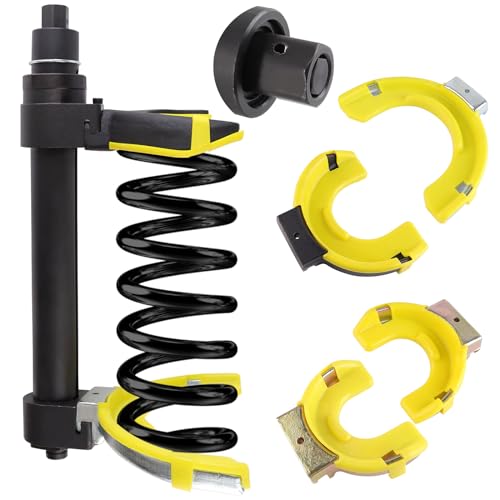 aremnry 2010ASCBest with carrying case
Why compressed springs are dangerous
A suspension spring is made to carry the weight of a vehicle. When you squeeze it with a compressor, you store that energy in the coil. If the tool slips, bends, or the spring shifts sideways, the energy comes out all at once. The spring or a loose part can strike hard enough to cause serious injury.
Most accidents come down to a few causes: a tool that is too weak for the spring, forks or jaws that do not sit properly on the coil, a spring that tilts as it compresses, or a person standing in the line of release. The tool itself is rarely the whole story. Fit, setup and technique matter just as much.
So the honest answer is that compressors are safe enough when chosen and used correctly, and unsafe when any of those pieces is off.
Does size make a compressor dangerous?
Size is one of the most common ways a compressor becomes unsafe. There are two numbers to match: the load rating and the spring diameter.
Load rating is how much force the tool is built to hold. Never use a tool rated below your spring's load. Our coil spring compressor comparison lists tools from 2200 lb up to 9921 lb, and stiff truck springs generally call for the higher end. Pick a rating well above what your spring needs, not just barely enough.
Spring diameter is the second check. Measure the outside diameter of your spring and make sure the forks or jaws are made for it. Forks that are too small or too large may not seat on the coil, which raises the chance of slipping.
| What to match | Example from our spec sheet | Why it matters |
|---|---|---|
| Load rating | Amerbm 2010ATH: 9921 lb; OMT 2328BX: 2200 lb; BILITOOLS B1F91601: 5512 lb | A tool under-rated for the spring can bend or fail |
| Fork range | Amerbm gold forks 2.6 to 4.9 in, black 3.4 to 6.3 in, silver 4.9 to 8.3 in | Forks must seat securely on your coil |
| Jaw range | OMT 2328BX jaws fit springs from 0.9 to 11 in. | A wide range still needs checking against your spring |
Safety features worth looking for
Design details can lower the risk, though none of them replace good habits. When you compare tools, look for these:
- Overload protection. The Amerbm 2010ATH and aremnry 2010ASC are described as having a safety pin that is meant to break first if too much load is applied.
- Safety lips or tongues on the forks. These are designed to help keep the spring from slipping off during compression.
- Heat-treated or forged steel. The listings for several tools describe heat-treated or forged components meant to resist bending under load.
- Interchangeable forks. Having a fork size that fits your spring is safer than forcing a near match.
- A locking feature. The OMT 2328BX listing describes a lock ring meant to hold the jaws in place while compressing.
Impact wrench or hand tool?
Powered tools save time, but they take away some feel. The Amerbm and aremnry listings say their rods are impact wrench compatible. In contrast, the OMT listing says not to use it with air or pneumatic tools, and the BILITOOLS listing recommends hand-tool operation with a 22 mm wrench or socket.
Always follow the instructions for your specific tool. If you do use an impact wrench where it is allowed, go slowly and stop often to check that the spring is still seated and straight. A hand tool is slower but lets you feel when something is wrong.
A safer routine, step by step
No routine removes all risk, but these steps address the usual causes of accidents. Read your tool's manual first, since details vary.
- Wear safety glasses or a face shield and sturdy gloves. Hearing protection is smart if you use an impact wrench.
- Check the tool for bent rods, cracked forks or worn threads. Do not use damaged gear.
- Confirm the load rating and fork range suit your spring before you start.
- Lubricate the threads, as the listings for several tools advise.
- Place the forks on opposite sides of the spring so they sit fully on the coil, with the spring centered and straight.
- Tighten in short steps and alternate sides if you use two compressors, so the spring does not become cockeyed. The OMT listing gives the same advice.
- Compress only as much as the job needs. Stop and recheck if the spring shifts.
- Keep your body out of line with the spring. Never put your face or hands near the ends of a compressed coil.
- Hold the strut or spring securely, in a sturdy vise or stand, rather than letting it hang from the compressor.
- Release the tension slowly and evenly when the job is done.
When to hand the job to a shop
Consider a professional if your spring is unusually stiff, your tool does not clearly match the spring, or something about the setup feels uncertain. Also stop if you cannot hold the assembly steady or do not have the right protective gear.
If you decide to buy, use the best coil spring compressor page to compare load ratings, fork ranges and safety features side by side. Matching the tool to the spring is the best protection you can build in before you start.
Frequently asked questions
Are two-piece clamp-style compressors safe?
They can work when used correctly, but they rely on you keeping both sides tightened evenly. Uneven tightening can tilt the spring, so alternate sides in small steps and keep the clamps seated on the coil.
Can I reuse a compressor that has been dropped or bent?
No. A bent rod, cracked fork or damaged thread can fail under load. Replace the damaged part or the whole tool before using it again.
Does a higher load rating always mean a safer tool?
Not by itself. A higher rating gives more margin, but the forks must also fit your spring's diameter and be seated properly. Rating and fit both need to match.
Do I need to check the winding direction of my spring?
With some kits, yes. The BILITOOLS listing says its version fits clockwise-wound springs and that a left-hand variant exists for counterclockwise springs, so check before you buy.