Are Car Racing Helmets the Same as Motorcycle Helmets?
No, they are not the same. Car racing helmets are built to Snell SA standards for enclosed cars, with fire resistance and HANS device compatibility. Motorcycle helmets follow standards such as DOT (FMVSS 218) for road riding. Some helmets list both, but you should never assume it, and you should check the rulebook before you buy.
 Conquer 350-FF-SA20-WHT-LBest overall
 Conquer 350-FF-SA20Same specs, second listing
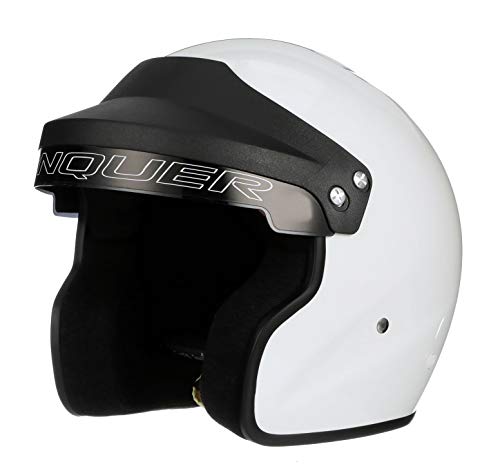 Conquer 350-OF-SA20-WHT-LLightest, but open face
The short version: same shape, different jobs
A car racing helmet and a motorcycle helmet can look alike. Both have a hard shell, an energy-absorbing liner and a chin strap. The difference is the situation each helmet was designed for.
A car driver sits in a cage or a car with a roll structure, strapped in, and faces fire risk and side impacts from the car body. A motorcyclist faces road contact, sliding and a wider range of impact angles. Each standard tests for the crash it expects.
That is why the rating on the label matters more than the look of the shell.
Ratings: Snell SA versus DOT and others
Car racing helmets are usually rated to a Snell SA standard. Our best racing helmets page recommends looking for a current SA rating, such as SA2025, and checking which rating your sanctioning body accepts.
Motorcycle helmets are usually rated to DOT (FMVSS 218), and some also carry other road or Snell M ratings. A road rating is what makes a helmet legal for street riding in most places.
Product listings can be confusing here. Both the Conquer 350-FF-SA20-WHT-L and the Conquer 350-FF-SA20 are SA2025 full-face helmets, and their listings say they are not intended for motorcycle road use or FMVSS 218 compliance. Other open face listings say they meet FMVSS 218 but are not designed for public streets or highways. Read the exact wording on the listing and treat a racing helmet as a racing helmet unless the seller clearly states otherwise.
Key differences you can feel and see
Beyond the label, the designs differ in a few practical ways.
- Fire protection: racing helmets list a fire retardant liner. Motorcycle helmets generally do not make that a core feature.
- HANS or HNR compatibility: racing helmets can include anchor points or M6 threaded inserts for a head and neck restraint. Several ILM listings mention M6 inserts, and the device itself is not included.
- Visor and eyeport: racing models often list tear-off posts and a flame resistant shield. The Conquer full-face models list a 3 mm visor with tear-off posts.
- Ventilation: car helmets often rely on vents and airflow for long sessions in a hot cabin. Motorcycle helmets use airflow from riding speed.
- Weight: listed racing helmet weights here run from 3.3 lb to 5.35 lb, but not every model lists one.
Side-by-side comparison
This table sums up the typical differences. Specific models vary, so confirm on the listing and in your rulebook.
| Feature | Car racing helmet | Motorcycle helmet |
|---|---|---|
| Typical rating | Snell SA (for example SA2025) | DOT (FMVSS 218), sometimes ECE or Snell M |
| Fire retardant liner | Commonly listed | Not typically a focus |
| HANS or HNR fit | Often supported | Usually not designed for it |
| Tear-off posts | Common on full-face models | Uncommon |
| Street legal | Not unless the listing states it and it truly carries a road rating | Yes, with the right rating |
| Main use | Cars with a cage or roll structure | Riding on the road or track |
Can you use a motorcycle helmet for car track days?
Sometimes, but it depends on the organizer. Some track day groups accept a motorcycle helmet with a Snell M rating, while others require a Snell SA rating. Rules change by event and by car class, so read the helmet section of the rulebook or ask the organizer first.
Even where it is allowed, a motorcycle helmet may not fit a HANS or HNR device. If you plan to wear one, you need a helmet built to accept it. That is a fit and safety issue, not just a paperwork one.
Can you use a racing helmet on a motorcycle?
On the road, generally no. A helmet that lacks a road rating may not be legal for street riding, and the listings for several of our compared models state they are not designed for public streets, roads or highways.
Even on a closed course, check the rules. Motorcycle track days commonly ask for a motorcycle-specific rating, and an SA-only helmet may be turned away. A car helmet was not designed around the crash and impact angles a rider faces, so it is the wrong tool for that job.
How to choose the right helmet
Start with where you will wear it, then work through the checklist below.
- Read your rulebook or local law for the required rating.
- Pick a current rating that matches, such as SA2025 for car racing.
- Check HANS or HNR compatibility if you will use the device. The Conquer GT does not list it.
- Decide between full face and open face. Open face models list no visor.
- Compare weight and features such as a double D-ring strap or sunshade strip.
- Check the size chart. Sizes vary widely, from one listed size to eight sizes, XXS to 3XL, on the RaceQuip PRO25.
Safety notes
Never wear a damaged helmet, and replace one that has taken a hard impact, even if it looks fine. Make sure the chin strap is fastened and snug every time. Wear eye protection if your helmet has no visor, and use hearing protection where engine or track noise is loud.
If you see our best racing helmets comparison, use it to line up ratings, weights and HANS compatibility before you decide.
Frequently asked questions
Does a Snell SA rating make a helmet street legal?
No. SA is a racing rating, not a road rating. Legal use on public roads depends on a road standard such as DOT, so check the label.
Why does fire resistance matter in a car helmet?
Car racing carries a fire risk that road riding does not. A fire retardant liner is a listed feature on many racing helmets for that reason.
Do I need a HANS device with any helmet?
Only if your series or rules call for it. If it does, the helmet must be built to accept the device, so check for listed compatibility before buying.
Is an open face helmet fine for car racing?
Some series allow it, others do not. Open face models leave the face uncovered and list no visor, so confirm what your rulebook accepts.