30/50 vs 40/60 Well Pump Pressure Switch: Which to Use?
For most homes, match the range your system already uses. If you have no strong reason to change, a 40/60 switch gives noticeably better shower and multi-fixture pressure, while a 30/50 switch suits small homes, older plumbing and equipment that is not rated for higher pressure. Never go higher than the lowest pressure rating of your pump, tank, plumbing and relief valve.
 YSD mc-1Best overall
 Square D FSG2J24CPBest known brand
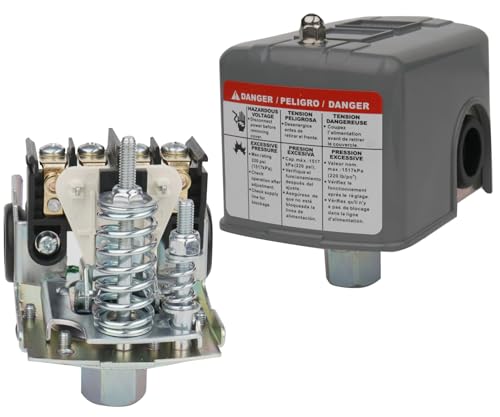 WHK WHK-PS01(40-60PSI)Best wiring flexibility
The short version: what the numbers mean
The two numbers on a pressure switch are the cut-in and cut-out pressures, in psi. A 30/50 switch starts the pump when tank pressure falls to 30 psi and stops it at 50 psi. A 40/60 switch starts the pump at 40 psi and stops it at 60 psi.
Both ranges have the same 20 psi gap between start and stop, so the pump runs for a similar stretch each cycle. The whole range simply shifts up by 10 psi. That shift is what you feel at the faucet: the 40/60 system delivers water with more force, and the 30/50 system is gentler.
Our well pump pressure switch comparison covers both ranges, along with 50/70 and 60/80 options, so you can see the specs side by side.
30/50 vs 40/60 at a glance
This table sums up the practical differences. The tank air figures follow the common rule of setting tank pre-charge 2 psi below cut-in.
| Feature | 30/50 psi | 40/60 psi |
|---|---|---|
| Cut-in (pump starts) | 30 psi | 40 psi |
| Cut-out (pump stops) | 50 psi | 60 psi |
| Gap between the two | 20 psi | 20 psi |
| Tank air pre-charge | 28 psi | 38 psi |
| Water force at fixtures | Gentler | Stronger |
| Strain on older pipes and fittings | Lower | Higher |
| Better for | Small, single-level homes | Multi-level homes, more fixtures |
When 30/50 makes sense
A 30/50 switch is a good fit when your home is small, has one level and has few fixtures running at the same time. Lower pressure is easier on the pump and gentler on older pipes, valves and appliance connections.
It also makes sense if your components are limited. Some older tanks, pressure relief valves and fixtures were set up around a lower range. If your system has always run at 30/50 and works well, there is no need to change it.
- Small or single-story homes
- Older plumbing you want to treat gently
- Systems where the pump or tank is only rated for lower pressure
- Households that are happy with current water force
When 40/60 makes sense
A 40/60 switch is the most common range, and it is the one our comparison page treats as the usual replacement choice. It is a better match for two-story homes, longer pipe runs and homes where a shower and a washing machine may run at once.
The higher starting point also leaves more pressure in reserve. When you open a fixture, the pressure has 10 more psi to drop before the pump has to start, which can make the water feel steadier.
Several 40/60 models in our data use stainless steel wetted parts, including the YSD 40/60 and the duekvek 40/60. The Merrill MPS4060 lists a 2 HP rating at 115 VAC, and the WHK 40-60 model lists a 1-year warranty and voltage ratings from 110 to 240 V. For a 30/50 option, the Cejiuga 30/50 uses brass wetted parts and an ABS housing.
Can you put a higher switch on your pump?
Often you can, but it does not automatically mean you should. Raising the range pushes more pressure through everything downstream of the pump. Before changing from 30/50 to 40/60, check three things.
First, check the pump. Make sure it can reach the higher cut-out pressure and still deliver a good flow. Second, check the pressure tank and look for its rated working pressure on the label. Third, check the pressure relief valve and make sure its setting sits safely above your new cut-out. Pipes, water heaters, softeners and faucet fittings also matter, so read their labels too.
If any component is rated below the new cut-out pressure, stay with your current range. The weakest part sets the limit for the whole system.
How to swap and set up the switch
The switch is a straightforward swap if you match the connection, voltage and motor rating. Most switches in our comparison use a 1/4 in female NPT thread. Check your motor's voltage and horsepower against the switch rating, since some switches are rated to 1 HP and others to 2 HP.
Safety first: this is a job with live electrical power and pressurized water. Turn off the breaker and lock it out so no one switches it back on. Confirm the power is off with a tester before you open the switch cover. If you are not comfortable working with household wiring, hire a licensed electrician.
- Turn off power at the breaker and lock it out.
- Open a faucet to drain the pressure from the system, then close it.
- Photograph the wiring, then label and disconnect the wires.
- Unscrew the old switch and fit the new one on the 1/4 in NPT connection.
- Reconnect the wires to the same terminals and close the cover.
- Set the tank air pressure 2 psi below the new cut-in, with the tank drained of water pressure.
- Restore power and watch a full cycle. Check that the pump starts and stops at the pressures you expect, using a gauge.
Signs you chose the wrong range
Rapid on-off cycling can point to a worn switch, a waterlogged tank or wrong tank air pressure. Do not assume the range is to blame before you check the air pre-charge, which is the most common cause.
If the pump starts but never shuts off, or the pressure at the gauge climbs above the cut-out setting, turn the power off and have the system inspected. A failed switch or a stuck contact can overpressure the system. The relief valve is there as a backup, so never plug it or remove it.
If water force is too low at 30/50 and your equipment allows it, a move to 40/60 may help. If it feels too strong, or fittings leak, go back to the lower range.
Frequently asked questions
Can I just adjust my current switch instead of buying a new one?
Many switches have an adjustable range and differential, and the specs in our comparison list this for the models shown. Adjustments change the start and stop points, so check your equipment ratings first and verify the result with a gauge.
Do I need to change the tank air pressure when I change the switch?
Yes. Set the pre-charge to 2 psi below the new cut-in, with the tank empty of water pressure. That means 28 psi for a 30/50 switch and 38 psi for a 40/60 switch.
Will a 40/60 switch make my pump work harder?
The pump must work against higher pressure at the top of each cycle, so there is somewhat more load. If your pump is rated for the range, this is normal operation.
Does the switch affect how long the pump runs each cycle?
Not much on its own. Both ranges have a 20 psi gap. Tank size and the amount of air in it have a larger effect on run time.