16 Gauge vs 18 Gauge Finish Nailer: Which to Use?
Use a 16 gauge nailer for heavier trim such as baseboards, door casings and crown molding, because the thicker nail holds better. Use an 18 gauge nailer for thin, delicate trim where a smaller hole and less splitting matter more than holding power. If you can own only one for general trim work, 16 gauge is the safer pick.
 Metabo HPT NT65MA4Best overall
 meite T64A with 2500 Nails (US)Light with jam release
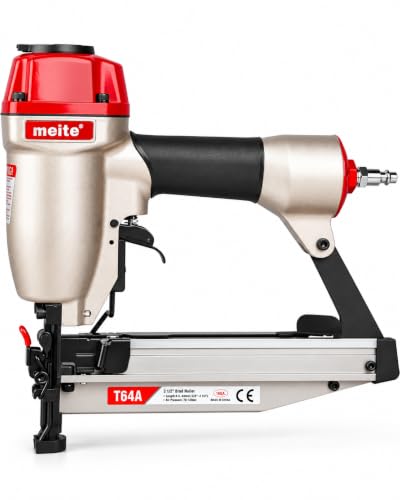 meite T64APlain T64A configuration
The short version: thickness is the trade-off
A lower gauge number means a thicker nail. A 16 gauge nail is thicker than an 18 gauge nail, so it grips harder and resists being pulled out. An 18 gauge nail is thinner, so it leaves a smaller hole and is less likely to split narrow or brittle wood.
That one difference drives almost every choice. Thick trim that gets bumped, slammed or pulled on needs the extra grip. Thin trim that mostly needs to stay put while glue dries needs the gentler nail.
Which gauge fits which job
Think about how much load the trim will carry and how visible the nail hole will be. Baseboards take knocks from vacuums and furniture. Door casings move every time a door closes. Those jobs favor 16 gauge.
Small moldings, thin shoe and quarter round pieces, and fine decorative trim are easier to damage. A thick nail can split them, and a large hole is harder to hide. Those jobs favor 18 gauge.
| Job | Better gauge | Why |
|---|---|---|
| Baseboards | 16 gauge | Needs holding power against everyday knocks |
| Door and window casings | 16 gauge | Thicker stock and frequent movement |
| Crown molding | 16 gauge | Heavier pieces need a firmer hold |
| Cabinet face frames | 16 gauge | Holds well in hardwood |
| Thin shoe or quarter round | 18 gauge | Less splitting on narrow pieces |
| Small decorative trim | 18 gauge | Smaller hole to fill |
| Holding parts while glue dries | 18 gauge | Light hold is enough |
Holding power versus hole size
With 16 gauge, you give up a little in finish quality to gain strength. The holes are larger, so you will fill and sand more, especially on stained wood where fillers can show.
With 18 gauge, you get cleaner results, but the nail can bend in dense hardwood and may not hold heavier pieces on its own. For trim that must last, many people pair thin nails with construction adhesive.
If you want even less visible holes on very small moldings, a pin nailer is a step beyond 18 gauge. Our best 23 gauge pin nailer page compares those tools.
What the spec sheets show for 16 gauge
Most 16 gauge nailers on our best finish nailer page accept nails from about 1.25 to 2.5 in. That range covers most baseboard, casing and cabinet work. The meite T64A, for example, is listed at 1.25 to 2.5 in, 3.86 lb, with a 100-nail magazine, tool-free jam release and tool-free depth adjustment.
Weight matters over a long day. Among the models on that page that list it, weights run from 2.8 lb to 7.34 lb. A lighter tool is easier to hold overhead or on stairs.
One note on gauge: that page also includes a 15 gauge model, the Metabo HPT NT65MA4, listed at 4.2 lb. A 15 gauge nail is thicker than 16 and holds heavier trim, casings and stair parts, so it is worth a look if your work leans heavy.
How to choose in four steps
Work through these in order.
- List the trim you will install most often and note its thickness.
- If most of it is baseboard, casing, crown or cabinetry, choose 16 gauge.
- If most of it is thin molding or delicate decorative pieces, choose 18 gauge.
- Check the nail length range on the listing and confirm it matches your stock, then look at weight and jam release.
Safety notes
Wear safety glasses every time you fire a nailer. Nails can ricochet or break, and air exhaust can blow debris toward your face. Hearing protection is smart too, especially in small rooms.
Keep your hand and body away from the nose of the tool, and never point it at anyone. Disconnect the air hose before clearing a jam, loading nails or making adjustments. Stay within the maximum air pressure on the tool's label, and check for hidden wiring or pipes before nailing into walls.
Which should you buy first?
For most homeowners doing baseboards, casings and general trim, a 16 gauge nailer is the better first tool. It covers the widest range of work and holds well.
Add an 18 gauge later if you do a lot of delicate molding. If you are weighing other nailer types too, our best nailer page gives a wider comparison.
Frequently asked questions
Can I use 18 gauge nails in a 16 gauge nailer?
No. Nailers are built for one gauge. The wrong nail can jam or misfeed and may damage the tool, so match the nail to the gauge printed on the tool.
Do 16 gauge nails need wood filler?
Yes, usually. The holes are small but visible, so fill them and sand lightly before painting or staining.
Is an 18 gauge nailer a brad nailer?
Yes. An 18 gauge nailer is commonly called a brad nailer, and it fires thin brad nails with a small head.
Should I use glue along with nails?
Often, yes. Glue adds hold on trim, and the nails keep the piece in place while the glue sets.