#1
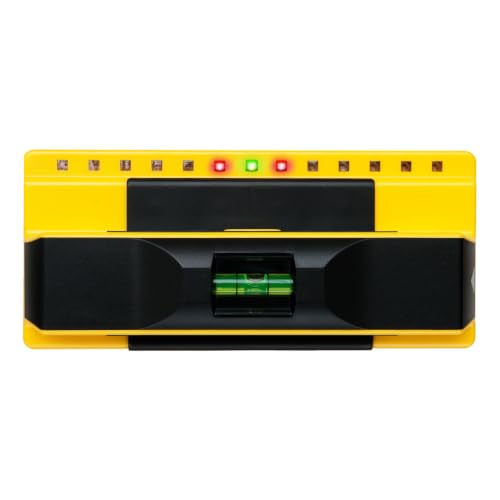
Franklin Sensors 317740851Franklin ProSensor M210 13-Sensor Stud Finder
13 sensors, live wire detection, a bubble level and 1.7 in depth in one tool.
- Max detection depth
- 1.7 in
- Number of sensors
- 13
- Live AC wire detection
- Yes
A good stud finder has to do a few things well. It should find wood and metal studs behind drywall or plaster, and show both edges so you can mark the full width. It should be simple to start, and live wire detection adds a safety check before you drill. Depth, sensor count, calibration and size all affect how it works on a shelf or TV mount. We put 11 products on one spec sheet so you can compare them directly.
Quick answer
Ranked from 11 stud finders that met our standard, compared on full stud width detection, wood and metal detection, max detection depth.
As an Amazon Associate I earn from qualifying purchases. Links to retailers on this site are affiliate links; we may earn a commission at no extra cost to you.
13 sensors, live wire detection, a bubble level and 1.7 in depth in one tool.

Lists live wire detection with 9 sensors in a 5.51 in body.

Reaches 2.5 in, the highest depth of all 11 products.
| Spec | ||||||||||
|---|---|---|---|---|---|---|---|---|---|---|
| Best Scoreout of 100 | 91 | 81 | 74 | 72 | 69 | 66 | 64 | 61 | 61 | 59 |
| Max detection depthin | 1.7 in | 1.5 in | 2.5 in (best in row) | 1.5 in | 1.6 in | 1.5 in | 1.6 in | 1.5 in | 0.8 in | 0.8 in |
| Number of sensors | 13 (best in row) | 9 | 13 (best in row) | 9 | 13 (best in row) | 7 | 13 (best in row) | — | — | — |
| Shows full stud width | Yes | Yes | Yes | Yes | Yes | Yes | Yes | — | — | — |
| Wood stud detection | Yes | Yes | Yes | Yes | Yes | Yes | Yes | Yes | Yes | Yes |
| Metal stud/pipe detection | Yes | Yes | Yes | Yes | Yes | Yes | Yes | Yes | Yes | Yes |
| Live AC wire detection | Yes | Yes | — | — | — | — | — | Yes | Yes | Yes |
| Calibration | None required (best in row) | None required (best in row) | None required (best in row) | None required (best in row) | None required (best in row) | None required (best in row) | None required (best in row) | Automatic | Manual | Automatic |
| Power source | AA batteries | AAA batteries | — | AAA batteries | — | AAA batteries | AA batteries | 9V battery | Rechargeable (best in row) | AAA batteries |
| Deep scan mode | Yes | Yes | Yes | Yes | Yes | Yes | Yes | Yes | — | — |
| Built-in level or laser | Bubble level | — | — | — | Bubble level | — | — | — | Laser level (best in row) | — |
| Display type | LED bar (best in row) | LED bar (best in row) | LED indicators | LED indicators | LED indicators | LED indicators | LED indicators | — | LED indicators | LED indicators |
| Weightlb | 0.71 lb | — | 1.10 lb | 0.32 lb | 0.40 lb | 0.31 lb (best in row) | 0.56 lb | — | 0.59 lb | 0.43 lb |
| Lengthin | 7.5 in | 5.5 in | 9.0 in | 5.4 in | 7.3 in | 4.6 in (best in row) | 7.0 in | — | 6.5 in | 8.9 in |
| Made in USA | Yes | Yes | Yes | Yes | Yes | Yes | Yes | — | — | — |
We reviewed 20 stud finders and kept only the 11 that pass every check below. Those are ranked by a Best Score built from spec fit for this job, sales rank.
These reviews are based on specifications and listing information only. Each one covers a top-ranked finder and what its specs mean for hanging shelves and mounting TVs.
Franklin M210 leads our ranking on features
The ProSensor M210 leads our ranking, and the spec sheet shows why. It has 13 sensors, which lets it read a wide patch of wall at once. It shows the full stud width on an LED bar, so you can mark both edges instead of guessing from a single point. No calibration is required.
Depth is 1.7 in, with deep scan on. Only the ProSensor MAX reaches deeper among these products. It finds wood and metal studs, and it also detects live AC wires, which matters when you drill for a TV mount. A bubble level and a pencil caddy help you hang a shelf straight. It runs on AA batteries.
At 0.71 lb and 7.5 in long, it is heavier and longer than the compact M90 and M70 models. The 13-sensor design is the main draw. Buyers who want the fewest steps and a safety check for wires get the most complete package here. Batteries are not included.
VerdictThe M210 is the most complete finder here for hanging shelves and mounting TVs, with wire detection built in.
M150 adds wire detection in a smaller body
The ProSensor M150 ranks second on our list. It has 9 sensors instead of the 13 on the leader, but it still shows the full width of a stud on an LED bar. The middle LED turns green at the stud center, so you know where to put the screw. No calibration step is needed.
Detection depth is 1.5 in, and deep scan is always on. It finds wood and metal studs. Live AC wire detection is included, which is the safety feature you want before drilling into a wall for a shelf or a TV bracket. The maker doesn't publish a weight for this model.
It is 5.51 in long and uses AAA batteries, so it is easy to store in a tool bag. It has no built-in level listed. If you want live wire detection without the larger body of the M210, this is the model to check. The maker says it is not compatible with rechargeable batteries.
VerdictThe M150 keeps the leader's core features, including wire detection, in a smaller body with 9 sensors and a 1.5 in reach.
ProSensor MAX is the deep-scan pick
The ProSensor MAX ranks third, and it is the one to look at for hard walls. Its max detection depth is 2.5 in, the highest of all 11 products on the page. The maker says it scans through two or more layers of drywall, plaster, OSB, plywood, MDF and large tile.
It has 13 sensors and shows the full stud width on LED indicators, with the middle LED turning green at the center. Two modes are available. Mode 1 works as a normal stud finder for drywall. Mode 2 is for deep scanning through thick or tough walls. No calibration is required.
The trade-off is size. At 1.1 lb and 9 in, it is the heaviest and longest of the models that list those specs. The listing does not mention live wire detection, so check for wires another way before you drill. The maker doesn't publish a power source or a built-in level.
VerdictThe MAX is the right choice for thick walls, but it is bulkier and lacks a listed wire alert.
M90 is a light 9-sensor finder
The ProSensor M90 ranks fourth. It weighs 0.32 lb and is 5.38 in long, so it is easy to hold at arm height when you scan a wall for a TV mount. Only the M70 is lighter among the eight models that list weight, and that gap is small.
It has 9 sensors and shows the full stud width on LED indicators. The middle LED turns green at the stud center. Deep detection reaches 1.5 in, and deep scan is always on. It finds both wood and metal studs without calibration, so you can start scanning anywhere, even over a stud.
The gaps are practical ones. The listing does not mention live wire detection or a built-in level. It runs on two AAA batteries, and the maker says rechargeables are not compatible. The 1.5 in reach is the same as the M150 and M70. Pick it for simple stud marking, then use a separate level and a wire check.
VerdictThe M90 is a good light option for stud marking, but it skips the wire alert and the level.
The 710+ adds a level and ruler
The ProSensor 710+ ranks fifth. It carries 13 sensors, the same count as the M210, and shows the full stud width on LED indicators. The middle LED turns green at the center. No calibration is required, so you press and hold the button and scan from any spot. This makes it a good match for marking both edges before you hang a shelf.
Depth is 1.6 in with deep scan always on, and it finds wood and metal studs. The built-in bubble level and integrated ruler are the useful extras. They help you keep a shelf straight and measure from the stud you just marked. At 0.4 lb and 7.25 in, it is the lightest of the 13-sensor models.
The listing does not mention live wire detection, so plan to check for wires another way before you drill. The maker also says it is not compatible with rechargeable batteries. It makes sense over the M210 if you want a lighter tool. Batteries are not included.
VerdictThe 710+ suits shelf hanging well because of its level and ruler, but wire safety is up to you.
Best among the reviewed tools
Depth tells you how thick a wall the tool can read through. Several listings reach 1.5 in to 1.7 in. The ProSensor MAX lists 2.5 in and two modes. Thick plaster, tile or double layers call for more depth. Two products list only 0.75 in.
A finder that shows the full width lets you mark both edges and the center. Franklin's ProSensor models use many sensors and LED displays to show the whole stud. The middle LED turns green at the center. That makes screw placement for shelves and TV mounts easier.
Live AC wire detection warns you about powered wires before you drill. The M210, M150, Zircon A250c, Prexiso and DEWALT DW0100 list it. The other Franklin models do not. Turn off power at the breaker before you drill either way.
The Franklin models need no calibration, so you can start scanning anywhere. The Prexiso needs manual calibration. The DEWALT and Zircon calibrate automatically. Length runs from 4.6 in to 9 in, and weight from 0.31 lb to 1.1 lb among models that list them.
Yes, if the tool lists metal detection. Each product shown here lists metal stud or pipe detection. The Franklin models say they find both wood and metal studs. The Zircon A250c also lists a metal scan mode for rebar and copper pipe.
Franklin says more sensors mean more accuracy. The ProSensor M210, MAX, 710+ and 710 have 13. The M150 and M90 have 9, and the M70 has 7. Among the models that list it, the range is 7 to 13.
Standard drywall needs less depth than plaster, tile or stacked layers. Most Franklin models here list 1.5 in to 1.7 in of depth with deep scan always on. The ProSensor MAX adds a second mode and reaches 2.5 in for thick or tough walls.
No. It adds a warning, but you should still turn off power at the breaker before drilling. Zircon's listing says to turn off power before drilling. Models without a listed wire alert, such as the ProSensor MAX, call for extra care.
Your own selection is kept in the link, so friends see the same side-by-side.