#1
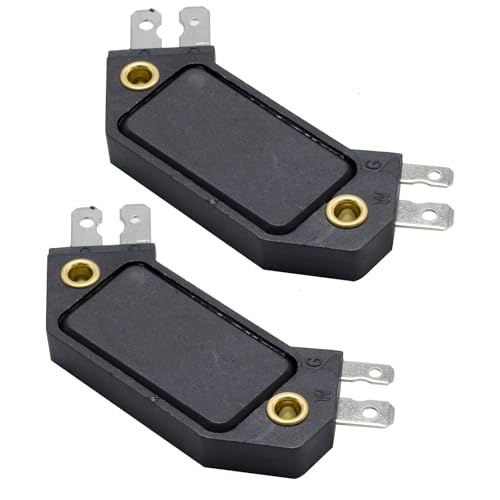
JDMSPEED JDM-D106JDMSPEED GM HEI 4 Pin Ignition Module
Copper slug heat sink and a listed -40 to 125 °C operating range.
- Max current
- —
- Top operating temperature
- 125 °C
- Warranty
- —
A good HEI module must match your distributor's model years and survive engine heat. Look at the year range, the OE part numbers it replaces, the heat sink design and any listed protection against shorts and static. Also check the operating temperature range and warranty if the maker publishes them. Many listings leave those blank. We put 6 products on one spec sheet so you can see what each maker states and what it leaves out.
Quick answer
Ranked from 6 ignition modules that met our standard, compared on GM year range fit, heat sink design, circuit protection.
As an Amazon Associate I earn from qualifying purchases. Links to retailers on this site are affiliate links; we may earn a commission at no extra cost to you.
Copper slug heat sink and a listed -40 to 125 °C operating range.

Lists short-circuit, over-voltage and ESD protection plus an internal current limit.

Weighs 0.00625 lb, matching QKYS as the lowest among models that list weight.
| Spec | ||||||
|---|---|---|---|---|---|---|
| Best Scoreout of 100 | 77 | 66 | 65 | 61 | 55 | 42 |
| Ignition system type | GM HEI 4-pin ignition module | Ignition control module | 4-pin performance ignition module | 4-pin HEI ignition control module | 4 pin GM HEI ignition module | GM HEI 4-pin ignition module |
| Model year coverage | 1,974–1,988 | — | 1,974–1,988 | 1,974–1,988 | 1,974–1,988 | 1,974–1,988 |
| OE part numbers replaced | D1906, DR100, CBE4, DS10071, LX-301, 1875990, 10482820 | D1906, 1875990, 10482820, 19180771, LX301, DM1906 | LX301, DM1906, 1190357, 4419628, 82369531 | D1906, 1894322, LX301, 1875990, LX-301 | LX301, DM1906, 1875990, 1190357, 4419628, 82369531 | LX301, D1906, DM1906, 1875990, 1190357, 4419628, 1894322 |
| Performance grade | Stock replacement | Stock replacement | Performance upgrade (best in row) | Performance upgrade (best in row) | — | — |
| Max currentA | — | — | — | — | — | — |
| Heat sink design | Copper slug (best in row) | OE-style thermal layout | Not specified | Not specified | Not specified | Not specified |
| Short-circuit/ESD protection | — | Yes | — | — | — | — |
| Operating temperature range°C | -40–125 | — | — | — | — | — |
| Weightlb | 0.22 lb | 0.09 lb | 0.01 lb (best in row) | — | 0.01 lb (best in row) | — |
| Pack quantity | 1 | 1 | 1 | 2 (best in row) | 1 | 1 |
| Warrantyyr | — | — | — | — | — | 1 year |
We reviewed 20 ignition modules and kept only the 6 that pass every check below. Those are ranked by a Best Score built from spec fit for this job, sales rank.
These reviews are based on specifications and listing information. Each one points out what the maker states and what it leaves unpublished.
Copper slug and a listed temperature range lead the ranking
This module ranks first on our spec sheet. It is a 4-pin GM HEI replacement covering model years 1974 to 1988. The maker lists a copper slug heat sink. That matters because heat is a common cause of module failure in an HEI distributor, and it can leave you with a no-start. It is the only model here that lists an operating temperature range.
The listing gives an operating range of -40 to 125 °C. It also names seven OE numbers: D1906, DR100, CBE4, DS10071, LX-301, 1875990 and 10482820. Match them to the number on your old module. The box holds one module. The grade is stock replacement, so expect factory-style behavior, not extra spark energy.
Two notes. At 0.22 lb it is the heaviest of the four models that list weight. The maker does not publish max current or short-circuit protection, so those points stay unknown.
VerdictA sound first pick for a 1974 to 1988 HEI distributor when heat resistance is your main worry.
Delphi lists the protection circuits the others skip
Delphi's DS10071 ranks second on our spec sheet. It is a stock replacement control module with a protection list that no other model here matches. The listing names short circuit, over-voltage and electrostatic discharge (ESD) protection. It also lists an internal current limit and voltage clamping circuits. Those features guard against electrical faults that can cause a no-start.
Heat handling is described as an original-equipment design layout meant to ensure adequate heat transfer and durability. That is less specific than a named heat sink material, and the maker publishes no operating temperature range. Cross-references include D1906, 1875990, 10482820, 19180771, LX301 and DM1906. With no year range listed, those OE numbers are your best fit check.
The listing gives no max current either. At 0.09 lb it weighs less than the JDMSPEED module but more than two others. Pack quantity is one, so it ships as a single unit. Confirm fit against your distributor's year before buying.
VerdictA careful pick for protection, as long as you verify fitment by part number before ordering.
Tied for lightest, with a performance label and thin specs
SYudwen sells a 4-pin module for model years 1974 to 1988 and ranks third on our spec sheet. That is the same range as every other model that lists one. It is one of two models here sold as a performance upgrade, not a stock replacement. The data does not say what the upgrade changes, so treat the word as a label.
OE numbers listed are LX301, DM1906, 1190357, 4419628 and 82369531. The listing only says it uses metal and plastic. The maker does not publish a heat sink design, operating temperature range, max current or circuit protection. For an HEI module that lives in a hot distributor, that leaves heat tolerance unconfirmed.
At 0.00625 lb it ties with the QKYS as the lightest of the four models that list weight. The listing also warns buyers to compare part numbers, not only model and year. Follow that advice before ordering. A single unit is included.
VerdictA fair option when the part number matches, but the listing gives little proof of heat durability.
Only two-pack here, with HEI-labeled fitment for four GM brands
Vkinman ships two LX301 modules in one pack, the largest pack quantity on the page. That suits someone who wants a spare on hand. It ranks fourth on our spec sheet for this keyword. The listing covers four makes: Chevrolet, Pontiac, Oldsmobile and Buick, all from 1974 to 1988.
It is a performance upgrade by label, and the listing says it is designed to improve ignition timing. The data gives no figure for that, so no spark gain is proven. The listing also says it is built to handle high temperatures and vibration, but the heat sink design is not specified. It claims more horsepower too, but no spec backs that up.
OE numbers include D1906, 1894322, LX301, 1875990 and LX-301. The maker does not publish weight, max current or circuit protection. Weight is missing, so it cannot be ranked with the other models. Compare your old module's number to this list first, before ordering.
VerdictA practical two-pack for GM owners, though the heat details stay unconfirmed.
A straightforward 4-pin GM HEI fit with few specs
QKYS ranks fifth on our spec sheet. It is a 4-pin GM HEI module for model years 1974 to 1988, and the listing says it fits V6 and V8 Chevrolet, Pontiac, Oldsmobile and Buick engines. No performance grade is given in the data. Engine fit is the clear focus.
The listing says the module resists high temperature, moisture and vibration. It gives no heat sink design, operating temperature range or max current to back that up. Those claims are the maker's words, not published ratings, so weigh them lightly. OE cross-references are LX301, DM1906, 1875990, 1190357, 4419628 and 82369531.
Weight is 0.00625 lb, tied with SYudwen as the lowest among the four models that list it. You get one module. The data lists no warranty and no circuit protection, so the spec sheet is thin for a part that must survive heat. Confirm the part number against your old module.
VerdictA workable fit for classic GM V6 and V8 engines, but it offers little proof of heat durability.
Best among the reviewed tools
Check the year range first. Five of the six modules here cover 1974 to 1988, but that is a wide span. Compare your old module's OE number to the cross-reference list, since part numbers are a tighter check than year and make alone.
Heat is a major stress for an HEI module. A heat sink design that is named, such as a copper slug, tells you more than a blank field. Four of the six listings do not specify a design, so a published operating range is a useful extra.
Short-circuit and ESD protection helps a module survive electrical faults. Only Delphi lists it in the data. If a listing is silent, that does not mean the module lacks it, but you cannot confirm it from the page.
Two models are sold as performance upgrades, and the data gives no numbers for what they change. A stock replacement aims at the original part's behavior. For a daily driver, a plain replacement that fits and stays cool matters more than a performance label.
On our spec sheet the JDMSPEED JDM-D106 ranks first. It lists a copper slug heat sink, a -40 to 125 °C range and coverage from 1974 to 1988. Delphi ranks second and is the only one that lists short-circuit and ESD protection.
Five of the six modules here list 1974 to 1988. Delphi does not publish a year range, so use its OE numbers, such as D1906 and 1875990, to confirm fit. Always compare against the number on your old module.
Heat is a common stress on these modules, which is why heat sink design matters. JDMSPEED lists a copper slug and Delphi lists an OE-style thermal layout. The other four do not specify a design in the data.
The data does not show it. SYudwen and Vkinman are labeled performance upgrades, but neither lists max current or a spark figure. JDMSPEED and Delphi are stock replacements. For a drop-in fix, fit and heat handling count first.
Your own selection is kept in the link, so friends see the same side-by-side.