#1
WINAMOO WITL111AWINAMOO 3-48V LED Digital Auto Test Light
Lightest listed at 0.44 lb, with a 3-48V digital display and polarity lights.
- Piece count
- 1 pcs
- Safety rating
- —
- Warranty
- —
A home mechanic needs a tool that answers simple questions: is the battery low, is the fuse blown, is the ground bad? Look for a clear voltage display, polarity lights, back probe access and a safety rating. Many listings are lead kits that need a multimeter, so check the tool type first. Piece count and terminal count matter less than whether the tool works alone. We put 9 products on one spec sheet and ranked them by specs.
Quick answer
Ranked from 9 automotive electrical test tools that met our standard, compared on back-probe inclusion, CAT safety rating, digital display.
As an Amazon Associate I earn from qualifying purchases. Links to retailers on this site are affiliate links; we may earn a commission at no extra cost to you.
Lightest listed at 0.44 lb, with a 3-48V digital display and polarity lights.
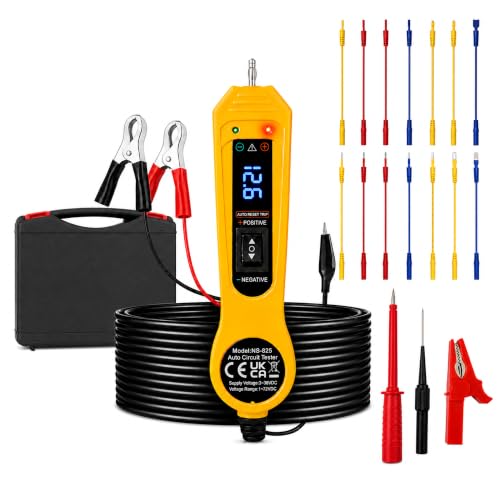
Reads 1-72V DC, the highest max voltage listed, and includes back probes and a case.

Ties for the most pieces (110) and terminals (72), but it needs a multimeter.
| Spec | |||||||||
|---|---|---|---|---|---|---|---|---|---|
| Best Scoreout of 100 | 67 | 57 | 64 | 60 | 59 | 56 | 50 | 50 | 70 |
| Tool type | Automotive test light with voltmeter | Automotive test light probe kit | Multimeter test lead kit | Automotive circuit test lead kit | Automotive circuit test lead kit | Automotive circuit test leads kit | Back probe test lead kit | Automotive circuit test lead kit | Automotive multimeter test lead kit |
| Piece countpcs | 1 pcs | — | 110 pcs (best in row) | 68 pcs | 76 pcs | 110 pcs (best in row) | 31 pcs | 76 pcs | 110 pcs (best in row) |
| Terminal countpcs | — | — | 72 pcs (best in row) | 48 pcs | 48 pcs | 72 pcs (best in row) | — | 48 pcs | 72 pcs (best in row) |
| Max voltageV | 48 V | 72 V | — | — | — | — | 30 V | — | 1000 V (best in row) |
| Digital display | Yes | Yes | — | — | — | — | — | — | — |
| Polarity indicator | Yes | Yes | — | — | — | — | — | — | — |
| Back probes included | — | Yes | Yes | Yes | Yes | Yes | Yes | Yes | Yes |
| Alligator clips included | Yes | Yes | Yes | Yes | Yes | Yes | Yes | Yes | — |
| Lead lengthin | 96 in (best in row) | — | — | — | — | — | 39 in | — | — |
| Safety rating | — | — | CAT III (best in row) | — | — | — | CAT II | — | CAT III (best in row) |
| Carrying case | — | Yes | Yes | Yes | Yes | Yes | — | Yes | Yes |
| Weightlb | 0.44 lb (best in row) | 1.23 lb | — | 2.54 lb | 2.43 lb | 5.31 lb | 0.51 lb | 2.43 lb | — |
| Warrantyyr | — | — | — | — | — | — | — | — | 2 years |
We reviewed 24 automotive electrical test tools and kept only the 9 that pass every check below. Those are ranked by a Best Score built from spec fit for this job, sales rank.
These reviews are based on specifications and listing information only. We cover the top five products in rank order and say plainly where a product does not fit this job.
A simple test light that suits 12V checks
The WINAMOO WITL111A is a test light with a built-in voltmeter. It reads 3-48V, which covers a 12V car system with room to spare. A digital display shows the voltage, and the listing gives a 0.1V resolution. That fine step helps you judge how charged a battery is.
Red and green lights show polarity, so you know which side of a circuit is live. The lead is 96 in long and ends in an alligator clip. You can clip to the battery and walk the probe to a fuse box or a tail light. The maker does not list back probes, but the sharp probe pierces insulation.
It leads our ranking and weighs 0.44 lb, the lightest of the seven models that list weight. The listing also names headlight, taillight and fuse checks. It is a single tool, not a kit. No safety rating is published, so keep it to 12V automotive work and avoid household circuits.
VerdictIt is the best fit here for a home mechanic who wants one easy tool for batteries, fuses and grounds.
A test light kit with real back probe access
The ATOBLIN 825 pairs a digital test light with a set of flexible leads. The display reads 1-72V DC, the highest max voltage among the three models that list it. That range is far beyond what a car needs. Red and green lights mark polarity. The tester itself runs from a 3-36V DC power source, so it suits 12V and 24V systems.
It combines a test light with back probe access in one case. The kit has 14 flexible leads, a large probe, a small probe and a mini alligator clip. The flexible leads bend to reach recessed connectors and crowded wiring harnesses. That matters when a connector has little room. Back probes let you check a live signal without cutting a wire.
A rocker switch sends battery power to a part, so you can test a relay, light or motor without removing it. Continuity mode checks wires, fuses and switches. The kit weighs 1.23 lb and comes in a hard carrying case. Its specs show no safety rating.
VerdictIt ranks second and is the best pick if you want a test light and back probes together.
A 110-piece lead kit for a multimeter
The LIIAMOAR 110P-KIT is not a tester on its own. It is a set of leads, probes and clips that plug into a multimeter. Check that your meter takes 4mm banana plugs. If you do not own one, you cannot diagnose anything with this kit. It ranks third because its specs are strong, but it fits the keyword only as an add-on.
On paper it is one of two kits with the top counts: 110 pieces and 72 terminals. It includes back probes, alligator clips and a carrying case. It also lists a CAT III rating, and the wire piercing probe clip is marked 1KV CAT III 10A. That is the only safety rating among the top five.
The maker does not publish a weight. The kit also has extras a beginner may never use, such as 5KOhm potentiometers and LED stroboscopes. That adds to the learning curve for a first-time buyer. Basic jobs like a dead battery do not need this many pieces.
VerdictBuy it as an upgrade for an existing multimeter, not as a first electrical tool for basic 12V jobs.
A 68-piece kit that needs your own meter
The LINXINO TD-TK2H-85JD is an automotive circuit test lead kit with 68 pieces. Like the other kits, it is an accessory, not a tester. You connect it to a multimeter or oscilloscope. For a first-time buyer, that means a second purchase before any testing can start. It cannot read a battery by itself. The listing says it suits cars, RVs, trucks and boats.
The kit lists 48 terminals, back probes, alligator clips and a carrying case. The listing names 2 potentiometers, 4 acicular probes and 2 LED stroboscopes. Back probes let you reach a connector pin from the rear. That helps with sensor wiring, but it is more than a basic fuse or battery check needs.
It weighs 2.54 lb, which is more than the 2.43 lb LIIAMOAR 76-piece kit. No CAT rating is listed for this kit. Keep it to low-voltage car circuits and use it on a meter with its own rating.
VerdictIt is a fair accessory kit, but it ranks fourth and does not diagnose problems by itself, so pair it with a meter.
A mid-size lead kit with four back probes
The LIIAMOAR ACTL-76P holds 76 pieces in a case with grooved foam. The listing counts 4 back probes, 4 puncture probes at 0.7mm, 2 large and 2 small alligator clips, and 2 double-ended clip leads. Those parts give several ways to reach a connector or wire. The leads plug into a multimeter with 4mm banana plugs.
It has the same specs as the ZrgGea 76-piece kit, and the listing says the leads are molded in one piece for flexibility and insulation. At 2.43 lb it is lighter than the LINXINO and Savildo kits. It does not state a CAT or other safety rating.
Like the others of its type, it is an add-on for a multimeter, not a complete tool. It will not read voltage alone. A home mechanic checking a dead battery or a blown fuse will find it more than needed. It makes sense once you move to sensor and connector work. Pair it with a meter you trust.
VerdictIt is a sound kit for a mechanic who owns a meter, but it ranks fifth as a first electrical tool.
Best among the reviewed tools
A test light with a voltmeter works by itself. A lead kit does not. It plugs into a multimeter, so you need one already. For a first-time home mechanic checking batteries, fuses and grounds, a standalone tool avoids a second purchase and a learning curve.
A car runs on 12V, so any range that covers it works. Wider ranges such as 1-72V or 3-48V add headroom. The listing for the Linkhood kit tops out at 30V. Check that the low end can read a weak battery and that the display shows decimals.
Back probes slide along a wire into a connector, so you can read a live signal without piercing insulation. Some kits list 4 back probes, and one test light kit includes them. A tool with only a sharp piercing probe works, but it leaves a small hole in the wire.
A safety rating such as CAT II or CAT III shows what the leads are built for. It matters most on mains circuits. For 12V car work the risk is low, but only 2 of the 8 products list a rating. If the maker gives none, stay with low-voltage jobs.
Yes, it can show battery voltage. The WINAMOO test light has a digital display for 3-48V and red and green polarity lights. A voltage reading shows the state of charge, but a battery can read normal and still fail under load.
Yes. The lead kits on this page, including the LIIAMOAR, LINXINO and Savildo sets, are accessories. They list terminals, probes and clips, but no display of their own. You connect them to a multimeter or oscilloscope that reads the signal.
A back probe is a thin pin that slides alongside a wire into the back of a connector. It lets you read a live signal without unplugging the part. The ATOBLIN 825, the Linkhood set and the larger lead kits all list back probes.
Usually not for 12V work, since car circuits are low voltage. The rating matters if you also use the leads on mains circuits. The LIIAMOAR 110-piece kit lists CAT III and the Linkhood kit lists CAT II. The other products on this page list no rating.
Your own selection is kept in the link, so friends see the same side-by-side.


