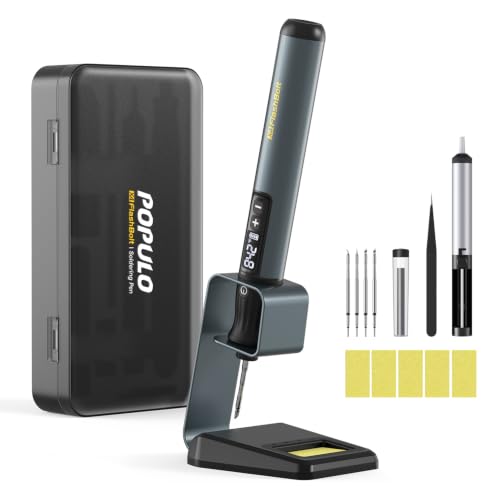
#1
HOTO QWJXA002HOTO SNAPBLOQ I-A06 Soldering Iron
Lists 140 W, the highest power on the page, with a 3 s heat-up.
- Power
- 140 W
- Max temperature
- 449 °C
- Heat-up time
- 3 s
Choosing a cordless soldering iron comes down to three things. Heat-up time tells you how long you wait before the first joint. Weight decides how tiring the iron is over a long job. Temperature control decides how steady the heat stays. We put 11 products on one spec sheet, so you can compare heat-up time, weight, power and temperature range side by side. Several models do not publish every spec, and we say so where that matters. Our ranking is based on specifications and listing information.
Quick answer
Ranked from 11 soldering irons that met our standard, compared on heat-up time, weight, and temperature control.
As an Amazon Associate I earn from qualifying purchases. Links to retailers on this site are affiliate links; we may earn a commission at no extra cost to you.
Lists 140 W, the highest power on the page, with a 3 s heat-up.

Lists a 2-year warranty, a ceramic heating element and a weight of 0.28 lb.

Includes three C210 tips, a solder sucker, tweezers and a stand, with a 5 s heat-up.
| Spec | ||||||||||
|---|---|---|---|---|---|---|---|---|---|---|
| Best Scoreout of 100 | 68 | 64 | 60 | 60 | 56 | 55 | 54 | 52 | 51 | 44 |
| PowerW | 140 W (best in row) | — | 16 W | — | 75 W | — | — | 10 W | 16 W | 16 W |
| Temperature range°C | 93–449 | 260–420 | 200–500 | 100–450 | 180–480 | 260–420 | 150–550 | 100–450 | 200–450 | 200–450 |
| Max temperature°C | 449 °C | 420 °C | 500 °C | 450 °C | 480 °C | 420 °C | 550 °C (best in row) | 450 °C | 450 °C | 450 °C |
| Heat-up times | 3 s (best in row) | — | 5 s | 3 s (best in row) | 3 s (best in row) | — | 7 s | 3 s (best in row) | 7 s | 12 s |
| Type | Cordless/battery | Cordless/battery | Cordless/battery | Cordless/battery | Cordless/battery | Cordless/battery | Cordless/battery | Cordless/battery | Cordless/battery | Cordless/battery |
| Digital temperature display | Yes | Yes | Yes | Yes | Yes | Yes | Yes | Yes | — | Yes |
| Temperature control | Digital/PID (best in row) | Digital/PID (best in row) | Digital/PID (best in row) | Stepped | Digital/PID (best in row) | Digital/PID (best in row) | Digital/PID (best in row) | Digital/PID (best in row) | Stepped | Digital/PID (best in row) |
| Auto sleep/standby | Yes | Yes | Yes | Yes | Yes | Yes | Yes | Yes | Yes | — |
| Tips includedpcs | 3 pcs | 3 pcs | 3 pcs | 3 pcs | 3 pcs | 3 pcs | 3 pcs | 3 pcs | 4 pcs (best in row) | 4 pcs (best in row) |
| Heating element | — | Ceramic | — | — | — | — | — | — | — | — |
| ESD safe | — | — | — | — | — | — | — | — | — | — |
| Weightlb | 0.33 lb | 0.28 lb | — | 0.30 lb | 0.26 lb (best in row) | 0.46 lb | — | 0.30 lb | 1.04 lb | — |
| Warrantyyr | — | 2 years | — | — | — | — | — | — | — | — |
We reviewed 43 soldering irons and kept only the 11 that pass every check below. Those are ranked by a Best Score built from spec fit for this job, warranty, sales rank.
These reviews are based on specifications and listing information. They cover the top five ranked irons, each from a different angle.
HOTO leads our ranking on power and heat-up speed
The HOTO SNAPBLOQ I-A06 leads our ranking. It lists 140 W, the highest power among the 11 products on the page. The listing says that figure applies when plugged in. On the built-in 2000mAh battery, it gives up to 60 W. That is still enough headroom for thick wires, RC connectors and ground planes away from an outlet.
Heat-up time is 3 s, which ties for the shortest listed. For field work, that means little waiting each time you pick it up. Temperature runs from 93°C to 449°C with digital PID control and a display. PID control holds the set temperature more steadily when the tip meets cold metal. Auto sleep is included too.
At 0.33 lb, it is light enough for bench work, though it is not the lightest listed. The kit has three tips: chisel, knife and bevel. The listing gives no warranty length or heating element type. Add a USB-C PD source and it can also run from a power bank.
VerdictIt is the strongest all-round cordless pick here, pairing a 3 s heat-up with the highest power on the page.
Larlarsa pairs a ceramic heater with a 2-year warranty
The Larlarsa ISCIENCE23 ranks second on our list. Its standout spec is the warranty, listed at 2 years. It uses a ceramic heating element, which the listing ties to steady heat during PCB work. Digital PID control, an OLED display and auto sleep cover the basics a portable iron needs for repair jobs.
Weight is 0.28 lb, close to the lightest listed at 0.26 lb. Lighter tools tire the hand less over many joints. The temperature range is 260°C to 420°C. The 420°C maximum is the lowest on the page, tied with one other model. Heavy joints may need more heat than that.
The maker does not publish a heat-up time or wattage, so you cannot compare its speed directly. The kit includes three tips, a solder sucker, solder wire and a stand. The listing gives a 1400mAh battery with USB-C PD charging. Auto sleep starts after 10 minutes idle. It suits small electronics better than heavy work.
VerdictA light, well-covered iron with a 2-year warranty, held back by its 420°C ceiling and missing speed figures.
Beizkna reaches 500°C but lists only 16 W
The Beizkna kit ranks third on our list. It lists 16 W, a low figure next to the 140 W leader. The listing explains that battery mode tops out at 12 W, and wired mode reaches 16 W. For small PCB work and wire below 18 AWG, that is workable. Thick terminals are a poor match.
Heat-up is 5 s, close behind the 3 s leaders. Temperature runs from 200°C to 500°C in 5°C steps, set with plus and minus buttons and shown on a digital display. Digital PID control and auto sleep are included. Sleep starts after 30 s at rest, and power-off follows after 10 minutes.
The maker does not publish a weight, so portability is hard to judge on paper. The built-in battery is 3200mAh, and the listing says it runs up to 60 minutes at 500°C. The kit includes three C210 tips, a solder sucker, tweezers and a stand. Run it from a USB-C charger or power bank for more power.
VerdictA capable small-repair kit with quick 5 s heat-up and a high temperature ceiling, but limited power and no weight listed.
FNIRSI HS-03 heats in 3 s but uses stepped control
The FNIRSI HS-03 ranks fourth on our list. Heat-up is 3 s, which ties for the shortest listed. That means the tip is ready almost as soon as you pick it up. The 2600mAh battery handles cordless work, and USB-C lets you solder while charging or with the battery removed. Sleep and standby times are adjustable, which saves battery between joints.
Temperature control is listed as stepped, not digital PID. A knob gives five quick levels, and buttons allow fine changes. Fine steps help when a joint needs slightly different heat. The range is 100°C to 450°C. If steady temperature matters most to you, the PID models above it are the safer reading of the specs. A digital display shows the setting.
At 0.3 lb, it is light, and the listing mentions a left and right hand mode and tool-free tip swaps. The kit has three tips for joints, precision and tight spaces. Power in watts and warranty length are not published. It suits small electronics repair, PCB work and field fixes.
VerdictA fast, light cordless iron whose stepped control is the main trade-off against the PID models above it.
ANBES is the lightest listed and heats in 3 s
The ANBES XF001 ranks fifth on our list, and it is the lightest iron here at 0.26 lb among the models that list weight. For field work, that can ease hand fatigue over long sessions. The listing adds a silicone grip sleeve and a magnetic stand that keeps the iron from rolling off a desk.
Heat-up is 3 s, tied for the shortest listed. Power is 75 W when wired through USB-C PD, and the listing gives a 30 W maximum on battery. That is well above the 12 W battery figure on some rivals. Temperature runs from 180°C to 480°C with digital PID control and a display that shows temperature and battery level.
Auto sleep uses a gravity sensor. The iron sleeps after 40 s idle, wakes when lifted and shuts off after 10 minutes. A built-in LED work light helps in dark enclosures. It comes with three C210 tips, and they snap in with a lock mechanism. Warranty length is not published.
VerdictA light, quick iron with PID control and good power for its size, best for mobile repair work.
Best among the reviewed tools
Heat-up time is how long the tip needs to reach working heat. Listed times here run from 3 s to 12 s. For field repairs where you pick the iron up and put it down often, a shorter time means less waiting between joints.
Many cordless irons deliver less power on battery than when plugged in. Some listings give 12 W on battery and 16 W wired, while the HOTO lists 60 W on battery and 140 W wired. Small PCB work needs little power. Thick wire and ground planes need more.
Digital PID control adjusts heater output to hold the set temperature. Stepped control gives fixed levels, which is simpler but less fine. Look for a digital display so you can see the setting. Also check the maximum: it ranges from 420°C to 550°C on this page.
Weight listed here runs from 0.26 lb to 1.04 lb, among the models that list it. A lighter iron tires your hand less. Battery runtime matters too: one listing says about 15-30 minutes per charge, so plan to solder while plugged in for long jobs.
Listed heat-up times on this page range from 3 s to 12 s. Four models list 3 s: the HOTO, FNIRSI, ANBES and PHINERIS. Two models do not publish a heat-up time. Actual speed also depends on the tip and the temperature you set.
Often not. Battery output on listings here includes 12 W and 60 W, and populo says its 16 W iron is not meant for thick-gauge wire. For heavy work, pick a model that lists high wired power, such as the HOTO at 140 W, and plug in.
It varies. Listings here cite up to 60 minutes for the Beizkna and Fanttik, up to 75 minutes for the populo, and about 15-30 minutes for the Qyvorae. Higher temperature and heavier work drain the battery faster. Several can run from USB-C power.
PID is a control method that adjusts heater output to keep the tip near the set temperature. Most models here list Digital/PID control. The FNIRSI and Fanttik list stepped control, which uses fixed levels instead. Fixed levels are simpler but give less fine control.
Your own selection is kept in the link, so friends see the same side-by-side.