#1
Ingersoll Rand 107XPAIngersoll Rand 107XPA 3/8 Air Ratchet
Lowest listed head height at 1.73 in, plus an adjustable exhaust and a power regulator.
- Max torque
- 54 ft-lb
- Free speed
- 160 rpm
- Weight
- 2.8 lb
Choosing an air ratchet comes down to a few numbers. Max torque shows how hard it can turn a stubborn fastener. Weight and head height decide how easily it fits and how tiring it is to hold. Free speed tells you how quickly it runs a socket down. Drive size sets which sockets fit. We put 5 air ratchets on one spec sheet so you can compare them line by line. Where a maker does not publish a number, we say so instead of guessing.
Quick answer
Ranked from 5 air ratchets that met our standard, compared on max torque, head height, and weight.
As an Amazon Associate I earn from qualifying purchases. Links to retailers on this site are affiliate links; we may earn a commission at no extra cost to you.
Lowest listed head height at 1.73 in, plus an adjustable exhaust and a power regulator.

Makes 60 ft-lb at 2.87 lb, but length and head height are not published.

Runs at 500 rpm and weighs 2.35 lb, with 40 ft-lb of torque.
| Spec | |||||
|---|---|---|---|---|---|
| Best Scoreout of 100 | 63 | 52 | 51 | 49 | 25 |
| Drive size | 3/8 in | 3/8 in | 3/8 in | 1/4 in | 3/8 in |
| Max torqueft-lb | 54 ft-lb | 60 ft-lb | 40 ft-lb | 35 ft-lb | 82 ft-lb (best in row) |
| Free speedrpm | 160 rpm | 160 rpm | 500 rpm (best in row) | 300 rpm | 280 rpm |
| Weightlb | 2.8 lb | 2.9 lb | 2.4 lb | 1.2 lb (best in row) | 4.7 lb |
| Overall lengthin | 11.0 in | — | 13.8 in | 5.4 in (best in row) | 23.0 in |
| Head heightin | 1.73 in (best in row) | — | 2.00 in | — | 2.25 in |
| Air consumptionCFM | 4.0 CFM | 4.0 CFM | — | 3.0 CFM (best in row) | 4.0 CFM |
| Operating pressurepsi | — | 90 psi | 90 psi | — | — |
| Adjustable exhaust | Yes | — | — | — | — |
| Power regulator | Yes | — | — | — | — |
| Warrantyyr | — | — | — | — | — |
We reviewed 7 air ratchets and kept only the 5 that pass every check below. Those are ranked by a Best Score built from spec fit for this job, sales rank.
These reviews are based on specifications and listing information. Each one explains what the numbers mean for buyers who want strong torque in a compact, lightweight tool.
Ingersoll Rand 107XPA leads our ranking for tight work
The Ingersoll Rand 107XPA leads our ranking. It has the lowest head height of the three models that list it, at 1.73 in. Head height decides whether the ratchet fits between a bolt and a nearby bracket. Low numbers help in engine bays and under dashboards.
It makes 54 ft-lb of torque from a 3/8 in drive. That is more than the AIRCAT 807-25 at 35 ft-lb, but less than the FORNAX at 60 ft-lb and the Astro 1120 at 82 ft-lb. It weighs 2.76 lb and measures 10.98 in long. Free speed is 160 rpm, which is the lowest on the page, shared with the FORNAX.
It is the only model on the page that lists an adjustable exhaust and a power regulator. The listing says the 360 degree exhaust directs air away from the operator. The regulator gives more control. Air use is 4 CFM, the same as the FORNAX and Astro 1120. The listing does not give operating pressure.
VerdictA balanced, low-profile ratchet that earns the top spot for tight access.
FORNAX LX2050-1 offers more torque than the leader
The FORNAX LX2050-1 ranks second on our spec sheet. Its 3/8 in drive makes 60 ft-lb of torque, which is more than the Ingersoll Rand 107XPA at 54 ft-lb. Only the Astro 1120 at 82 ft-lb goes higher. Torque is what breaks loose a stubborn nut, so it matters on stuck fasteners.
Weight is 2.87 lb and free speed is 160 rpm. That puts it close to the 107XPA on both counts, though it is slightly heavier. The listing describes an aluminum housing, an ergonomic handle and a forward and reverse switch within easy reach. Those details point to comfortable use in long jobs, though the listing gives no measured proof of that.
The key gap is size data. The maker does not publish overall length or head height here, so you cannot confirm that it fits a tight spot. The listing calls the profile slim. Air use is 4 CFM at 90 psi, which is the pressure the listing asks for. Check your compressor before you buy.
VerdictA strong 3/8 in option when torque matters more than published size data.
Astro 1130 is the fast, slim, extended option
The Astro 1130 runs at 500 rpm, the highest free speed on the page. Free speed controls how fast a socket spins down a loose bolt. That saves time on long threads. The trade is torque. At 40 ft-lb it makes less than the 107XPA at 54 ft-lb and the FORNAX at 60 ft-lb.
It weighs 2.35 lb and is 13.75 in long. The extra length keeps your hand away from obstructions, according to the listing. Head height is 2 in, taller than the 1.73 in on the 107XPA. The listing calls it the lowest profile model with a socket attached, but that is the maker's claim, not something our data confirms.
It is built for 3/8 in drive Nano sockets, and it includes a 3/8 in square drive for common socket types. Operating pressure is 90 psi and the inlet is 1/4 in. The listing gives no air consumption figure, so check that your compressor can keep up with a high speed tool.
VerdictA quick, extended ratchet for light fastening, not for breaking bolts loose.
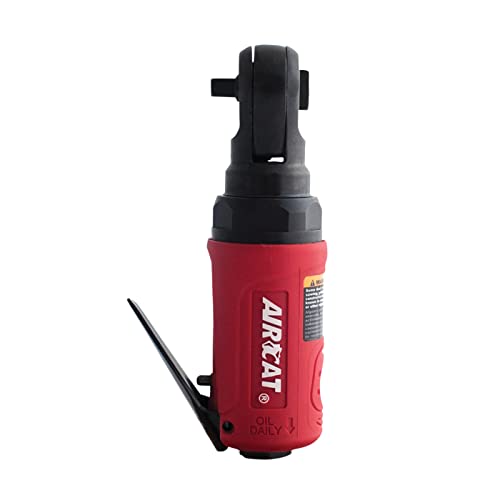
AIRCAT 807-25 is a mini ratchet for very tight spots
This is a different kind of tool. The AIRCAT 807-25 has a 1/4 in drive and fits in the palm of your hand, per the listing. It is the lightest model on the page at 1.23 lb and the shortest at 5.4 in. It ranks fourth on our spec score. If your jobs are small and cramped, those numbers matter.
The cost is power. Its 35 ft-lb is the lowest max torque here, and its 1/4 in drive is smaller than the 3/8 in drive on the other four. It spins at 300 rpm, faster than three of the other models. That helps with quick rundown, not with stuck bolts.
Air use is 3 CFM, the lowest among the models that list it. The listing mentions a quick socket release button and an ergonomic handle. Head height, operating pressure and the exhaust options are not published. For general automotive work, most buyers will want a 3/8 in drive instead.
VerdictPick it as a small helper for cramped spots, not as your main ratchet for heavier work.
Astro 1120 trades compactness for the most torque
The Astro 1120 makes 82 ft-lb, the highest max torque on the page. It also runs at 280 rpm, so it is not slow. If raw power is your priority, this is the strongest ratchet listed. It ranks fifth on our spec score, though, because the rest of its size numbers work against it.
This is a long reach tool. It is 23 in long, the longest on the page, and it weighs 4.72 lb, the heaviest. Head height is 2.25 in, the tallest of the three models that list it. That does not match a buyer who wants a compact, lightweight ratchet for tight spaces.
The extra length can keep your hand clear of obstructions when a bolt sits deep in a recess. The listing recommends a 3/8 in hose for the 1/4 in NPT air inlet. Air use is 4 CFM. The listing also describes a high power motor. Operating pressure, exhaust controls and a regulator are not listed.
VerdictRight for deep, stubborn bolts, but wrong for compact work.
Best among the reviewed tools
Max torque is the force the tool can apply, in ft-lb. Higher numbers loosen stuck fasteners. Lower numbers suit light assembly. Here the range runs from 35 ft-lb to 82 ft-lb. Remember that more torque usually comes with a bigger, heavier body.
Head height is how tall the ratchet head is. A lower number fits tighter gaps. Overall length affects reach and hand clearance. Among the models that list head height, the range is 1.73 in to 2.25 in. Not every maker publishes these numbers, so check before you buy.
Weight matters for overhead and long jobs. The models here run from 1.23 lb to 4.72 lb. Drive size sets your socket choice. Four of the five use a 3/8 in drive, and one uses 1/4 in. A 1/4 in drive suits small fasteners and a 3/8 in drive suits general work.
Air consumption in CFM must fit your compressor. Three models list 4 CFM, and one lists 3 CFM. Operating pressure, where listed, is 90 psi. An adjustable exhaust and a power regulator add comfort and control, but only one model here lists them.
It depends on the fasteners. Light assembly needs little. Stuck nuts need more. The ratchets here range from 35 ft-lb to 82 ft-lb. For a balance of torque and size, the FORNAX at 60 ft-lb and the Ingersoll Rand at 54 ft-lb sit in the middle.
Among the three models that list head height, the Ingersoll Rand 107XPA is lowest at 1.73 in. The Astro 1130 lists 2 in and the Astro 1120 lists 2.25 in. The FORNAX and AIRCAT do not publish this number.
A 3/8 in drive suits general work and appears on four of the five models here. The 1/4 in AIRCAT 807-25 is the lightest at 1.23 lb, but its 35 ft-lb is the lowest torque listed.
Among the models that list it, air use is 3 CFM to 4 CFM. The AIRCAT lists 3 CFM. The Ingersoll Rand, FORNAX and Astro 1120 list 4 CFM. The FORNAX and Astro 1130 list 90 psi operating pressure. Compare these with your compressor output before buying.
Your own selection is kept in the link, so friends see the same side-by-side.